Briefly describe the impact of water quality on textile printing and dyeing
Many people have misunderstandings or do not understand “Brief description of the impact of water quality on textile printing and dyeing“. Next, let me take you with me to share it with your friends and explore more about “ Briefly describe the influence of water quality on textile printing and dyeing” knowledge…
(1) The difference between soft water and hard water:
Water is divided into soft water and hard water. Water that does not contain or contains a small amount of calcium and magnesium ions is called soft water, and vice versa is called hard water.
Hard water is divided into:
(1) Temporary hard water: The hardness component of water, if caused by sodium bicarbonate or magnesium bicarbonate, is temporary hard water (boiling temporarily hard water, decomposed sodium bicarbonate, and the resulting insoluble carbonate And precipitation, water changes from hard water to soft water).
(2) Permanent hard water: If it is caused by sulfates or chlorides containing calcium and magnesium, it is permanent hard water and cannot be removed by boiling.
The above two hardnesses are collectively called the total hardness. , roughly divided according to the total hardness value of water:
The total hardness of 0-30ppm is called soft water, the total hardness of 60ppm and above is called hard water, high-quality drinking water does not exceed 25ppm, and the total hardness of high-quality soft water is below 10ppm.
In natural water, unpolluted rainwater and snow water away from cities are soft water; spring water, stream water, river water, and reservoir water are mostly temporary hard water, and some groundwater is high hardness water.
When water droplets condense in the atmosphere, they dissolve carbon dioxide in the air to form carbonic acid. Carbonic acid eventually falls to the ground with rainwater, and then seeps through the soil to reach the rock layer, where it dissolves lime (calcium carbonate and magnesium carbonate) to produce temporary hard water. This is how hard water in and near caves in some areas is formed.
The impact of water quality on fabric printing and dyeing:
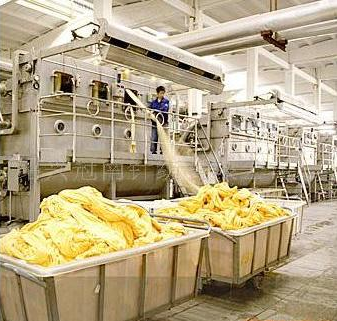
Due to different water sources, the water quality of printing and dyeing factories is also different. The water hardness in southern my country is lower, while the water hardness in northern areas is higher. Generally, printing and dyeing factories mostly use natural surface water or underground water and tap water.
Untreated natural water contains various chemicals, mainly calcium, magnesium, iron, sodium, carbonate, sulfate, and chloride, which will have a great impact on the color of fabrics.
The quality of fabric printing and dyeing also has certain requirements relative to water quality. The consequences of hard water: it will affect the bleaching effect, uneven coloring, poor fabric feel, and yellowing of the fabric. Adding a water softener requires increasing the amount of caustic soda and Dosage of other additives.
Calcium and magnesium, which are insoluble in water, will precipitate on fabrics, form scale in alkaline solutions, and adhere to equipment to hinder production. When the iron and manganese salts in the water exceed the standard, rust spots and catalytic oxidation are likely to occur during cooking. Cotton fiber. When bleaching with oxidants, iron, manganese, and salt also catalyze the decomposition of the bleach.
Factors affecting the coloring quality of water include: chroma, ph value, iron ion content, calcium ion content, etc.
When using reactive dyes for coloring, the impact of water hardness is not great, but when using acid dyes to dye nylon, the impact of water hardness is more prominent. Hard water not only makes the color of the fabric poor, but the CI in the water has a negative impact on the fabric. Color also has a big impact.
The suspended solids in hard water affect the bleaching whiteness of the fabric. When dyeing cheese yarn, it will easily reduce the color brightness of the inner and outer layers of the cheese yarn. The high pH value of water quality will affect the level dyeing of light-colored fabrics, because under alkaline conditions , the dye added will be fixed, resulting in poor level dyeing and dyeing flowers.
If the pH value of the water is too high, the dye will be hydrolyzed during the soaping process, resulting in poor reproducibility. If the water is too soft, the pH value of the cloth will exceed the standard.
Excessive iron ions will cause color spots, color flowers, and color wilt. Excessive manganese ions are the main cause of yellowing of bleached fabrics.
Hard water quality affects the brightness of colors and can cause scaling of the heat exchanger, resulting in large energy losses. Insoluble precipitates generated by calcium and magnesium ions and soda ash can also cause the phenomenon of [alkali spot].
Briefly describe the impact of water quality on fabric printing and dyeing
AAAGFREGRTTHR
Through the above description of “Brief description of the impact of water quality on textile printing and dyeing“, you will be interested in “Brief description of the impact of water quality on textile printing and dyeing” What are your understanding and thoughts about b>”, or if you are interested in purchasing fabrics, you are welcome to leave your comments below on the website!
Disclaimer:
Disclaimer: Some of the texts, pictures, audios, and videos of some articles published on this site are from the Internet and do not represent the views of this site. The copyrights belong to the original authors. If you find that the information reproduced on this website infringes upon your rights and interests, please contact us and we will change or delete it as soon as possible.
AA